
A practical framework for designing learning experiences in the age of AI
Most educational interventions focus on content.
The Four Power Model begins somewhere else.
It starts with a simple observation: information does not become learning simply because it is presented. Before knowledge can be understood, applied, or remembered, a series of interconnected cognitive processes must occur.
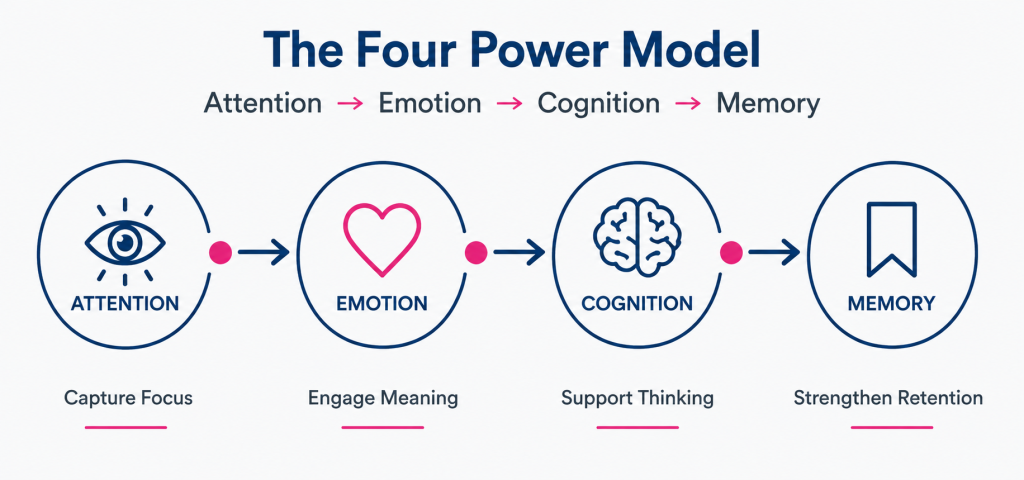
The Four Power Model proposes that effective learning depends on four interconnected forces:
Attention → Emotion → Cognition → Memory
When one element is weak, the entire learning experience suffers. When all four are intentionally designed, learning becomes more engaging, meaningful, and memorable.
1. Attention
Learning begins with attention.
In a world of constant notifications, multitasking, and algorithmic competition for our focus, attention has become one of the scarcest educational resources.
No matter how valuable the content may be, learning cannot occur if learners do not notice, engage with, or sustain focus on it.
Questions for educators and trainers:
- What captures attention?
- What maintains attention?
- What distracts attention?
- How can attention be restored when it drifts?
Attention is the gateway through which all learning enters.
Without attention, the remaining stages cannot function effectively.
2. Emotion
Attention alone is not enough.
The brain gives priority to information that carries emotional significance.
Emotion influences:
- motivation
- engagement
- curiosity
- confidence
- perceived relevance
Positive emotions such as curiosity, interest, and a sense of accomplishment increase the likelihood that learners will remain engaged. Negative emotions such as anxiety, confusion, or boredom can either hinder learning or, when appropriately managed, create productive cognitive challenge.
Effective learning experiences do not ignore emotion. They intentionally design for it.
Questions for educators and trainers:
- Why should learners care?
- What emotional experience are they having?
- Are we creating curiosity or merely delivering information?
Emotion provides energy for learning.
3. Cognition
Once attention is captured and emotion is engaged, the learner can begin the work of thinking.
Cognition includes:
- understanding
- analyzing
- problem-solving
- decision-making
- creating connections
- applying knowledge
This is where learning moves beyond exposure and becomes active mental processing.
However, cognition has limits.
When learners are overwhelmed by excessive information, unnecessary complexity, or poorly designed instruction, cognitive overload occurs.
Effective learning design reduces unnecessary mental effort while preserving meaningful intellectual challenge.
Questions for educators and trainers:
- What thinking do learners need to do?
- Are activities aligned with learning goals?
- Is cognitive effort productive or overwhelming?
Learning happens through thinking, not through exposure to information alone.
4. Memory
Learning is only successful if it endures.
Memory is not a storage system that automatically records everything we encounter. It is a dynamic process shaped by attention, emotion, and cognition.
Information is more likely to be remembered when learners:
- pay attention to it
- connect with it emotionally
- actively process it
- revisit it over time
Memory transforms momentary learning experiences into lasting knowledge and skills.
Questions for educators and trainers:
- What should learners remember?
- How will knowledge be reinforced?
- Are opportunities for retrieval and application built into the learning experience?
Memory is where learning becomes durable.
Why the Four Power Model Matters
Many educational challenges can be traced to the neglect of one or more of these four elements.
Learners may forget because memory was not supported.
They may disengage because emotion was overlooked.
They may become overwhelmed because cognition was overloaded.
Or they may never begin learning because attention was never captured.
The Four Power Model provides a practical lens for evaluating and designing learning experiences across contexts, including:
- higher education
- professional development
- corporate training
- online learning
- AI-mediated education
- workshop facilitation
Rather than asking only, “What content should we teach?”, the model encourages a deeper question:
How do we design learning experiences that attract attention, engage emotion, support cognition, and strengthen memory?
Applications
The Four Power Model is currently used within Attento AI to support:
- Faculty development workshops
- Online course design
- AI-enhanced learning experiences
- Educational consulting projects
- Professional training programs
- Conference workshops and presentations
As artificial intelligence transforms how information is accessed, generated, and distributed, the ability to design experiences that intentionally support attention, emotion, cognition, and memory becomes increasingly important.
Learning is not powered by information alone.
It is powered by attention, emotion, cognition, and memory working together.