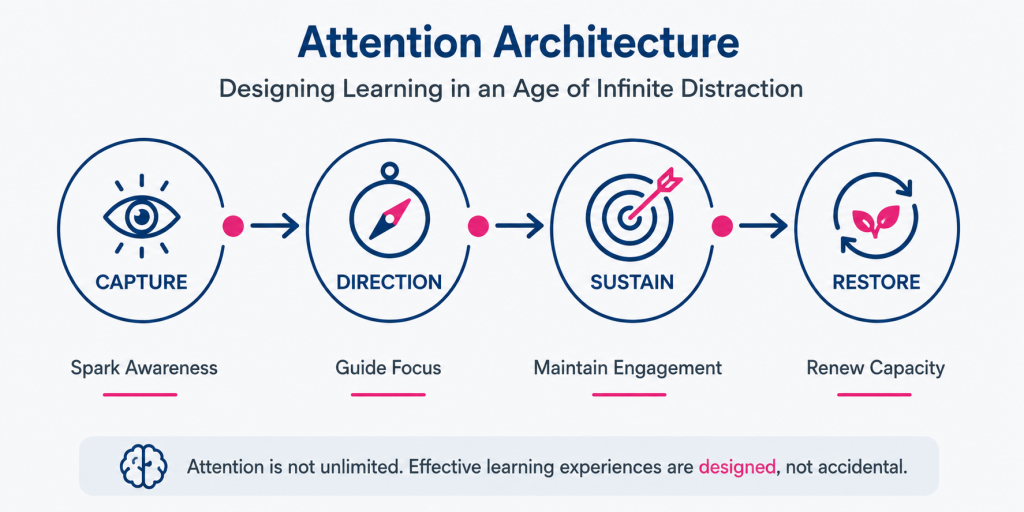
Designing Learning in an Age of Infinite Distraction
A framework for understanding how attention is captured, directed, sustained, and restored
For centuries, education assumed attention was largely available.
Today, attention competes with notifications, social media feeds, messaging platforms, AI assistants, algorithmic recommendations, and countless digital interruptions.
The challenge facing educators is no longer simply delivering information.
The challenge is designing environments in which attention can survive long enough for learning to occur.
Attention Architecture is a framework for understanding and intentionally designing the conditions that support human attention in digital and AI-mediated environments.
Rather than viewing attention as a personal trait or a learner’s responsibility alone, the framework treats attention as something shaped by the environment.
The central question becomes:
How is attention being designed?
The Four Layers of Attention Architecture
1. Capture
Attention begins with noticing.
Before learners can engage with content, something must first capture their awareness.
Capture is influenced by:
- novelty
- relevance
- surprise
- curiosity
- visual design
- emotional significance
Questions:
- Why would someone pay attention to this?
- What makes this worth noticing?
- Does the opening create curiosity?
Without capture, learning never begins.
2. Direction
Capturing attention is not enough.
Attention must be directed toward what matters.
In many digital environments, attention is captured successfully but directed toward the wrong things.
Examples include:
- decorative visuals
- unnecessary animations
- irrelevant information
- distracting interface elements
Questions:
- What should learners focus on?
- Is the interface helping or competing with learning?
- Are signals and priorities clear?
Direction transforms attention from reaction into purpose.
3. Sustain
Learning requires sustained attention.
This is often where educational experiences fail.
Learners may begin engaged but gradually lose focus due to:
- cognitive overload
- fatigue
- excessive complexity
- lack of interaction
- insufficient relevance
Attention is not a switch.
It is a resource that fluctuates over time.
Questions:
- How long can attention realistically be maintained?
- What opportunities exist for interaction?
- Are attention resets built into the experience?
Sustained attention creates the conditions for deep thinking.
4. Restore
Perhaps the most overlooked dimension of attention is restoration.
Human attention is not unlimited.
Focus naturally declines.
Effective learning environments acknowledge this reality and provide mechanisms for recovery.
Examples include:
- reflection activities
- pauses
- discussion
- variation in task type
- movement
- moments of consolidation
Questions:
- Where can learners recover attention?
- Are breaks viewed as interruptions or part of learning design?
- Is the experience cognitively sustainable?
Restoration allows attention to renew itself.
The Attention Architecture Model
Capture → Direction → Sustain → Restore
Unlike traditional views of attention that focus primarily on concentration, Attention Architecture emphasizes the entire attentional journey.
Learning experiences succeed when all four components are intentionally designed.
When one component is neglected:
- attention may never start
- focus may drift
- cognitive overload may occur
- learners may disengage
Attention Architecture and AI
Artificial intelligence changes attention in two important ways.
First, AI can support attention.
Examples include:
- personalized learning pathways
- adaptive explanations
- immediate feedback
- cognitive scaffolding
Second, AI can undermine attention.
Examples include:
- excessive automation
- reduced cognitive effort
- constant task switching
- overreliance on AI-generated summaries
The challenge is not whether AI should be used.
The challenge is whether AI systems are designed to strengthen or weaken human attention.
Attention Architecture provides a lens for evaluating that question.
Applications
The Attention Architecture framework can be applied to:
Higher Education
Designing courses that maintain learner engagement.
Professional Training
Creating workshops that support focus and retention.
Online Learning
Reducing digital distraction and cognitive overload.
AI-Augmented Education
Evaluating how AI tools affect attention and learning.
Workplace Learning
Designing sustainable knowledge work in attention-fragmented environments.
Key Principle
Attention is not merely a characteristic of the learner.
Attention is a property of the relationship between people and environments.
If learning is the goal, attention must be designed.
That design begins with understanding how attention is captured, directed, sustained, and restored.